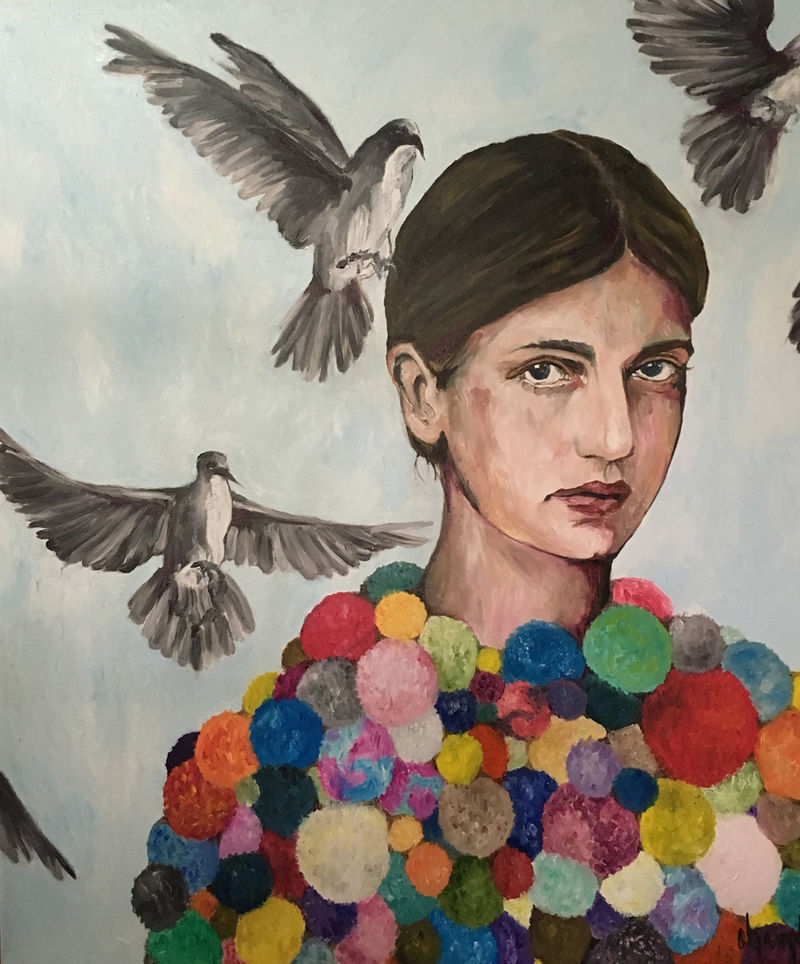
Begin before the explanation
Give a portrait a little time before reading the label. Notice where your attention lands, how close the figure seems, and whether the painted person appears to acknowledge your presence. You do not need to identify a style or solve a symbolic puzzle immediately. The first encounter supplies useful observations that a detailed explanation can sometimes replace too quickly. Keep those observations provisional rather than treating them as a final interpretation.
Describe what is visible in ordinary language. A face turns away; one hand is hidden; a bright flower interrupts a dark background. These statements create a foundation for later questions. They are different from saying that the person is secretive, frightened, or happy. An emotional response matters, but it becomes more interesting when you can identify which visual choices prompted it. Looking closely means moving between what is there and what you think it might suggest.
Notice the distance the artist creates
A tightly cropped head places the viewer in a different relationship with the subject than a small figure in a large room. Examine how much space surrounds the person and which parts of the body are included. A cropped shoulder, an incomplete hand, or a face touching the edge can create pressure. Open space may suggest calm, isolation, anticipation, or something less easily named, depending on the surrounding decisions.
Consider the viewing angle as well. Looking slightly upward, downward, or straight ahead changes the encounter even when the expression stays similar. Do not assume that a compositional choice carries one fixed meaning. Ask how it works in this particular painting. Compare the figure's scale with the space around it, then step back and see whether your sense of closeness changes. The frame is an active part of the portrait rather than a neutral boundary around a face.
Follow the gaze without making it a verdict
Eyes can draw attention, but a portrait's gaze includes more than the direction of the pupils. The angle of the head, the shape of the eyelids, and the relationship between the face and the body all contribute. A direct gaze can feel open or guarded. A downward glance can seem thoughtful without proving that the person is sad. Keep the difference between an observation and a psychological conclusion visible.
Look away from the eyes briefly and examine the mouth, jaw, and neck. Then return to the face as a whole. A small tension in one area may complicate your first impression. Portraits often sustain attention because their signals do not agree completely. Rather than choosing one emotion and stopping, describe the ambiguity. You might notice a formal pose with a relaxed hand, or a quiet face surrounded by restless marks. Those contrasts give the image room to remain unresolved.
Read gesture and objects together
Hands, shoulders, clothing, and nearby objects can establish a rhythm that the face alone does not explain. Trace the direction of an arm or the curve of a collar. Notice whether an object is held, worn, ignored, or placed beyond reach. Its position can matter as much as its identity. A flower beside a figure behaves differently from a flower covering part of the face.
Resist turning every object into a dictionary entry. A bird does not mean the same thing in every artwork, and a particular color cannot by itself establish the sitter's character. Ask what the object does within the composition: does it repeat a shape, redirect the eye, introduce another texture, or disturb the expected scale? Cultural and personal associations can add meaning, but they should be grounded in the work and its documented context rather than presented as universal rules.
Look at how the surface is made
A portrait can alternate between convincing illusion and openly visible marks. Examine an edge where skin meets background or hair meets clothing. Is it sharply described, softly merged, scratched, layered, or left incomplete? Those changes tell you where the painter asks for precision and where the viewer must help complete the image. A detailed eye beside an abbreviated shoulder can organize attention without making the rest of the painting unfinished.
If you are looking at a photograph online, remember its limits. Glare, image compression, lighting, and screen settings can alter the appearance of a surface. A raised addition or a metallic detail may be difficult to understand from one view. Use the caption to identify the stated medium and look for a detail photograph when one is available. Do not invent a material because a digital texture resembles it. An accurate question is more useful than a confident guess.
Bring in context after you have looked
Now read the title, date, medium, and any artist statement associated with the work. Notice which details reinforce your initial observations and which introduce a different direction. A title can suggest a narrative without closing every possible interpretation. A collection statement may explain recurring concerns while leaving the individual figure deliberately ambiguous. Treat context as another layer of attention, not an instruction to discard your own experience.
In an archive, distinguish a date assigned to the artwork from the date of an exhibition or a website capture. A photograph published later does not necessarily establish when the painting was made. Similarly, an old availability note does not describe the work's current location. These distinctions matter when discussing a portrait publicly. Good interpretation depends on accurate description of the object and accurate description of what is actually known about its history.
Compare without turning difference into a ranking
Place two portraits in conversation. Compare the distance to the subject, the handling of the background, the direction of the gaze, and the role of secondary objects. You may find that two very different color schemes create a similar feeling of stillness, or that related faces produce different encounters through cropping alone. Comparison helps you see decisions that familiarity might otherwise make invisible.
Choose a specific question for the comparison rather than asking which painting is better. One work may explain the face clearly while another gives more attention to the surrounding atmosphere. Both approaches can be purposeful. When writing notes, name the choices and their effects instead of awarding a general score. This keeps the conversation useful to someone who has not yet seen the works and leaves room for that person to respond differently.
Leave with a more precise observation
After a few minutes, return to the detail that first attracted you. Has it changed in importance? Perhaps the flower now seems to organize the whole image, or the hand carries more emotional weight than the eyes. Write one sentence describing that change in your attention. A portrait does not need to reveal a hidden answer for the encounter to have deepened.
The most useful habit is repeatable: look, describe, question, consult context, and look again. You can use it with a large painting in a gallery or a carefully captioned image in a portfolio. Avoid forcing certainty when the work remains open. A thoughtful response can be both personal and precise, acknowledging what the picture makes you feel while remaining attentive to the visible choices that make that feeling possible.
Illustration: We live in a colorful world from the original art archive. This editorial guide is not presented as a new statement by the artist.