Choose a subject you can stay with
Observation drawing begins with a subject that holds your attention long enough to study. It does not need to be unusual. A folded cloth, a plant, a chair, or a familiar object can offer more useful information than a complicated arrangement chosen mainly to seem impressive. Select a position where the subject and lighting are reasonably stable, then decide how long you intend to work.
Give the session a specific purpose. You might study the relationship between two large shapes, the way an edge changes, or how a shadow describes a surface. A focused aim helps you recognize progress even when the finished page does not look polished. It also makes the session easier to repeat. Learning to see a proportion more accurately is a meaningful result, whether or not the drawing becomes something you want to frame or share.
Establish the whole before the detail
Begin with the broad extent of the subject on the page. Notice its overall height, width, and placement, then lightly indicate the largest divisions. These early marks remain adjustable. Their purpose is to establish relationships that later details can inhabit. A beautifully described corner becomes difficult to use if the rest of the subject has no room to fit around it.
Compare distances within the drawing rather than treating every measurement as independent. How wide is one part in relation to another? Where does an important angle meet the outer boundary? Look back and forth between subject and page, checking several relationships before committing to a small area. This approach is not a demand for mechanical precision. It creates a structure that lets expressive marks remain connected to the observed arrangement.
Use the spaces around the subject
Negative space is the shape around or between the objects you are drawing. Looking at it can interrupt the tendency to draw a familiar symbol instead of the form actually in front of you. The opening between a chair's legs, for example, can be considered as a shape with its own proportions rather than as an empty place left over after drawing the chair.
Choose one of those spaces and compare its angles with the objects that define it. If the space looks wrong, the surrounding relationships may need adjustment. This offers another way to check a drawing without repeatedly tracing the same outline. Move between positive and negative shapes throughout the session. Each provides information about the other, and the change in attention can reveal an error that remained invisible while you were concentrating only on the named object.
Let edges carry different information
Not every boundary needs the same kind of line. Some edges appear clear, others soften into a similar value, and some are interrupted by light or overlapping forms. Observe those differences before making the entire subject equally outlined. A continuous heavy contour can describe the object's identity while flattening the conditions that make it particular.
Experiment with pressure, interruption, and overlap in a small study. Ask which marks clarify the form and which merely repeat information already present. An edge can become more convincing when part of it is left for the viewer to infer. Avoid treating this as a trick to apply everywhere. The decision should come from the observed relationships and the kind of drawing you want to make. Variation becomes useful when it answers something you have actually noticed.
Group the light and dark passages
Before adding many intermediate tones, identify the broad light and dark groups. Compare the deepest dark with the lightest area and ask how the middle values connect them. A drawing can lose clarity when every small variation receives equal emphasis. Larger groups provide a framework in which selected details can become more meaningful.
Keep returning to the whole page. A shadow that looks convincing in isolation may become too strong when compared with the rest of the drawing. Similarly, an untouched paper area can appear brighter because of what surrounds it. Work relationally rather than trying to reproduce every local tone independently. If you are uncertain, make a separate small value study. It can help resolve the overall arrangement without forcing repeated changes into a drawing whose surface is already becoming crowded.
Treat correction as part of the record
Revising a mark is not evidence that observation has failed. It often shows that you have looked again and found a more useful relationship. Decide whether a correction should remain visible, be softened, or be removed according to the purpose of the drawing. A study can preserve evidence of searching, while a presentation drawing may require a different degree of clarity.
When a section repeatedly resists you, step back to the larger structure. The problem may not be in the detail you keep adjusting. A misplaced major angle can make every smaller measurement feel unstable. Take a short break, change where you look first, or compare the subject's broad silhouette with the page. These actions help you reconsider the drawing without treating one stubborn area as the only place where an answer can be found.
Make repetition purposeful
Drawing the same subject again can reveal more than constantly choosing a new one. Change one condition: the time available, the scale of the page, the tool, or the aspect you study. A five-minute drawing and a longer tonal study ask different questions. Compare them in terms of what each makes visible rather than expecting them to achieve identical results.
Keep a few dated notes with the studies. Record the purpose of the session and one observation that changed your approach. Over time, those notes can show a development that is difficult to recognize from memory alone. Avoid judging progress only by how closely a drawing resembles a photograph. Clarity of attention, confidence in relationships, and the ability to revise deliberately are also substantial parts of learning.
Decide when the session has answered its question
A drawing can continue indefinitely if the only stopping rule is perfection. Return to the aim you set at the beginning. Have you understood the proportion, edge, or value relationship you wanted to investigate? If so, stop while that learning remains visible. Another session can explore a different question without requiring this page to contain every possible solution.
Place the work where you can review it after some distance from the session. Identify one strong decision and one unresolved relationship, then use that observation to choose the next study. This turns drawing into a continuing practice of attention rather than a series of verdicts on talent. The page becomes a record of looking: what you noticed, what you tested, and what became clearer when you were willing to look again.
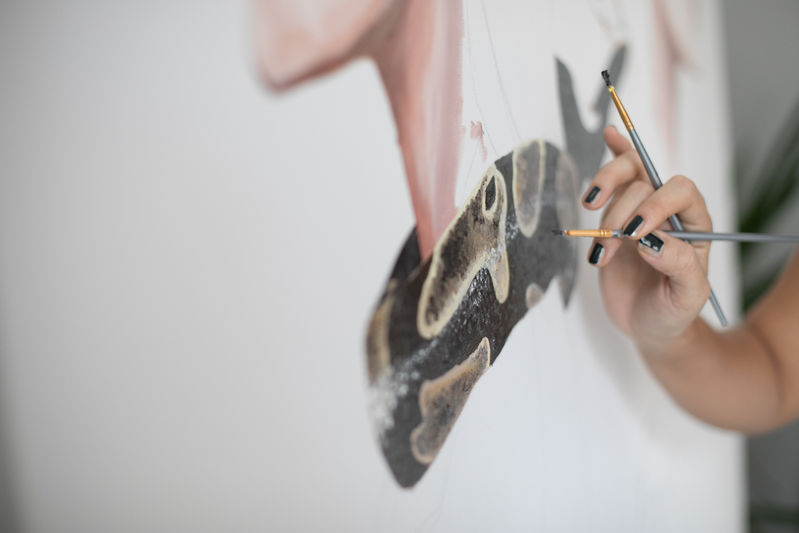
Illustration: Portfolio study 01 from the original art archive. This editorial guide is not presented as a new statement by the artist.