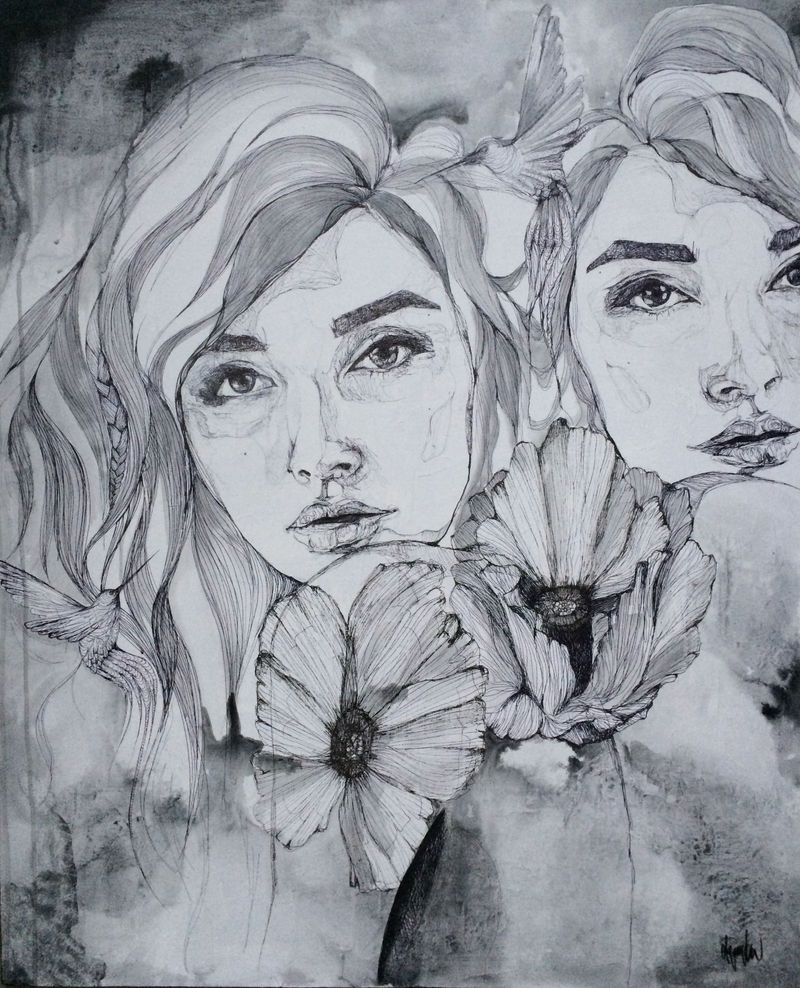
Begin with the plant or animal as a shape
Before asking what a flower or bird symbolizes, notice how it occupies the image. A stem may divide the surface, a wing may repeat the angle of a shoulder, or a cluster of petals may interrupt the outline of a face. These visual relationships are available even when the species is unknown. They offer a grounded beginning for interpretation without requiring a symbolic answer before you have examined the composition.
Describe the motif's scale and position. Is it smaller than expected, enlarged, partly concealed, or placed where something else would normally appear? A natural form can feel familiar while its relationship with the figure becomes strange. That combination often creates narrative possibility. The image does not need to illustrate a complete story; a single unexpected arrangement can invite the viewer to imagine a connection that remains unresolved.
Distinguish identification from interpretation
Recognizing a species can add context, but resemblance in a stylized painting does not always establish a precise botanical or zoological identity. If a caption names a heron, hummingbird, or particular flower, that is useful evidence. If it does not, describe the visible form carefully and leave the identification open. An invented certainty can send the interpretation down a path the image does not support.
Interpretation begins when you ask why that form matters in this work. Its associations may be personal, cultural, formal, or several things at once. A bird can contribute a shape, an imagined movement, and a narrative suggestion without carrying one stable message. Keep those possibilities distinct. Saying that an image suggests watchfulness to you is different from claiming that a bird universally represents watchfulness or that the artist intended exactly that reading.
Look for a relationship with the human figure
When natural motifs appear beside a person, examine the exchange between them. Do they seem to look toward one another, share a contour, overlap, or remain separate? A branch growing across a face creates a different relationship from a branch held in a hand. The first may complicate the boundary of the body, while the second establishes a gesture involving an object.
Consider which element appears to lead the encounter. A small animal can redirect the viewer's attention away from the face; a large flower may become almost another portrait. Look for moments where the figure and motif seem to borrow qualities from each other. The work may allow an association between human character and an animal without resolving it into a literal transformation. Such ambiguity can be part of the image's strength rather than a puzzle that needs to be completed.
Notice beauty and unease together
Delicate natural forms can appear within an unsettling atmosphere. A graceful stem, a carefully painted petal, or a bright wing may coexist with a dark field, an obscured face, or an uncertain gesture. Instead of choosing whether the work is beautiful or disturbing, examine how those responses develop together. The contrast can make each quality more noticeable.
Ask which details prevent the image from becoming purely decorative. Perhaps the scale is improbable, the arrangement feels too close, or the figure does not respond as expected. Conversely, ask which details keep a dark subject from becoming visually closed. A small passage of color or a fragile line may create a point of openness. These observations allow you to discuss tension without assuming that darkness always means distress or that flowers always make an image reassuring.
Read a collection as a developing vocabulary
A motif becomes more informative when you see it across several works. Compare where it appears, which materials describe it, and what changes around it. Repetition does not necessarily mean repetition of a message. An artist may use a familiar bird or flower to test different relationships between figure, background, scale, and movement.
The restored portfolio includes collection notes connecting some work with nature and some with imagined characters or inner traits. Those statements offer context for looking, but they should not be forced onto every image indiscriminately. Read the note associated with the relevant collection and compare it with what you can actually see. A later work may extend an earlier concern while changing its tone. Following those changes is often more rewarding than assigning a fixed definition to a recurring object.
Consider how materials affect the motif
A natural form can be drawn, painted, collaged, stitched, or added as a raised element. Its material treatment changes how it relates to the surrounding image. A painted butterfly and a three-dimensional paper butterfly can share a subject while creating different boundaries between represented space and physical surface. Look for captions that establish the actual materials before describing the process.
When viewing photographs, use multiple images if they are available. A frontal view may clarify composition while a detail reveals an edge or attachment. Do not assume that every apparent shadow belongs to the painted scene; it may come from a raised material or the conditions of photography. The distinction can alter how you understand the work. Careful attention to the object prevents interpretation from depending entirely on an impression created by one reproduction.
Bring historical associations in carefully
Flowers and animals have appeared in many artistic traditions, but an association documented in one context cannot automatically be transferred to another. If you consult a historical source, identify the tradition, period, and circumstances it describes. Then ask whether there is evidence connecting that context with the artwork you are studying. A resemblance can support a question without proving a direct influence.
An artist's own statement can also be selective or evolving. It may explain a starting point rather than prescribe every possible response. Use it to refine your questions, not to silence careful looking. When writing about a motif, separate the artist's documented account, a historical reference, and your personal interpretation. Those distinctions make the writing more trustworthy and give other readers room to participate in the conversation without having to accept an unsupported universal claim.
Keep the image open to another encounter
Finish by returning to the motif as a visible thing. Notice a contour, a patch of color, or a relationship you had not seen initially. The process of interpretation should lead back to the work rather than replace it with a story that could have been written without looking. A useful reading makes a specific image more available to attention.
You can practice with two works that share a natural form. Describe the placement in each, compare the figure's relationship with it, and identify one difference in atmosphere. Then write a short account that uses tentative language where the evidence remains open. Flowers and birds are powerful partly because they are recognizable yet never exhausted by a single meaning. Giving them room to operate visually, materially, and imaginatively preserves the complexity that makes them worth looking at again.
Illustration: black hummingbirds from the original art archive. This editorial guide is not presented as a new statement by the artist.